BOKK Library – News & Updates:
Update 1: ‘And so it begins!’
We have to start somewhere on this seemingly impossible task, and where we proposed to start is here…
the FRAW site, January 2006
First, a little history
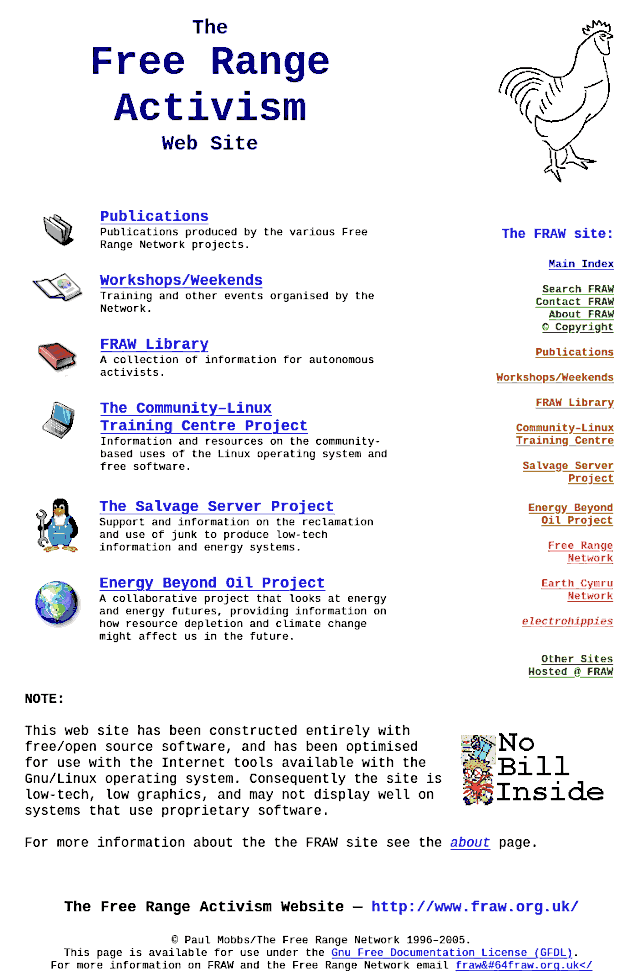
In 1994, for an early workshop run by the loose group that would soon become the Free Range Network, we produced a CD of files to give-away to the participants on the day.
At the time ‘the web’ had barely begun; and our use of the Internet was entirely text-based – primarily email. The first widely-used browser, Netscape, would not be released until the end of that year; and the ‘PDF file’ had only just become publicly available (at that time the ‘reader’ was free, but writing PDFs required a paid-for program).
In early 1995, that six-hundred megabyte CD of files had an HTML-1 index page added – in effect creating a website on a CD. Given the meagre options which seemed available it looked like that was where it would stay. Then in 1996 we got a fifty megabyte folder on GreenNet’s server – and pretty much instantly filled it using just the best/most desirable resources from the CD. About three years later we registered the domain name ‘fraw.org.uk’ – which has been our on-line home ever since.
Fast-forward to late 2023: Over those twenty-eight years the FRAW site has ballooned to well-over two gigabytes of data across 6,500 files. It’s a mish-mash of Network member’s data, old Free Range workshop resources, as well as copies of critical reports and journal papers the public really need access to for local campaigns (but which are held hostage behind paywalls). It’s been reworked and patched, and has had no major ‘review’ for over a decade – and some of the files have not been updated at all and remain in their original HTML-1 coding from 1995!
Most importantly: As search engines now have ‘issues’ with rating/recommending radical content – if they show it at all! – much of that two gigabytes of data is pretty-much inaccessible by keyword search. Something had to happen because there was practically no point running this unusable, impenetrable mass of data any more.
The need for change
A rough calculation was performed: Number of files; multiplied by the amount of content/graphics data each files holds; multiplied by the likely time per megabyte of data to review, recode, or touch-up that text or visual information.
The result: Overhauling the entire web site using our limited time and resources was going to take two to three years to carry out.
So we went ahead and did it!
Two years after that process began we can now start to churn-out a revised web site from now until, in phases. Hopefully the process will be completed in late 2026.
These are very strange times compared to the world our original Network/web site were created under. Just as the original CD/FRAW web site were created to address the situation for activists in the 1990s, then reworked it on the early 2010s to address the social media ‘revolution’, the situation today has change massively. We’re now removing all integration with social media to prevent tracking, and eliminating binary formats to avoid the possibility of embedded tracking/watermarking codes (a problem with PDFs, Office files, etc.) allowing tracking of our site’s users.
In our view, we have reached a point where must look at developing new forms of activism operating around a very different set of principles, just as we did in the mid-1990s when the ‘new media’ first became widely available to the public. Except this time the motivator for change is not simply new technology; it’s new technological tools being used by a failing economic class to repress people’s right to expression and communication, obstructing the historic basis for political organizing and making change.
We’ve written a more ‘political’ description of that process, and why it is urgently necessary, as a separate blog post.
The new ‘Library’
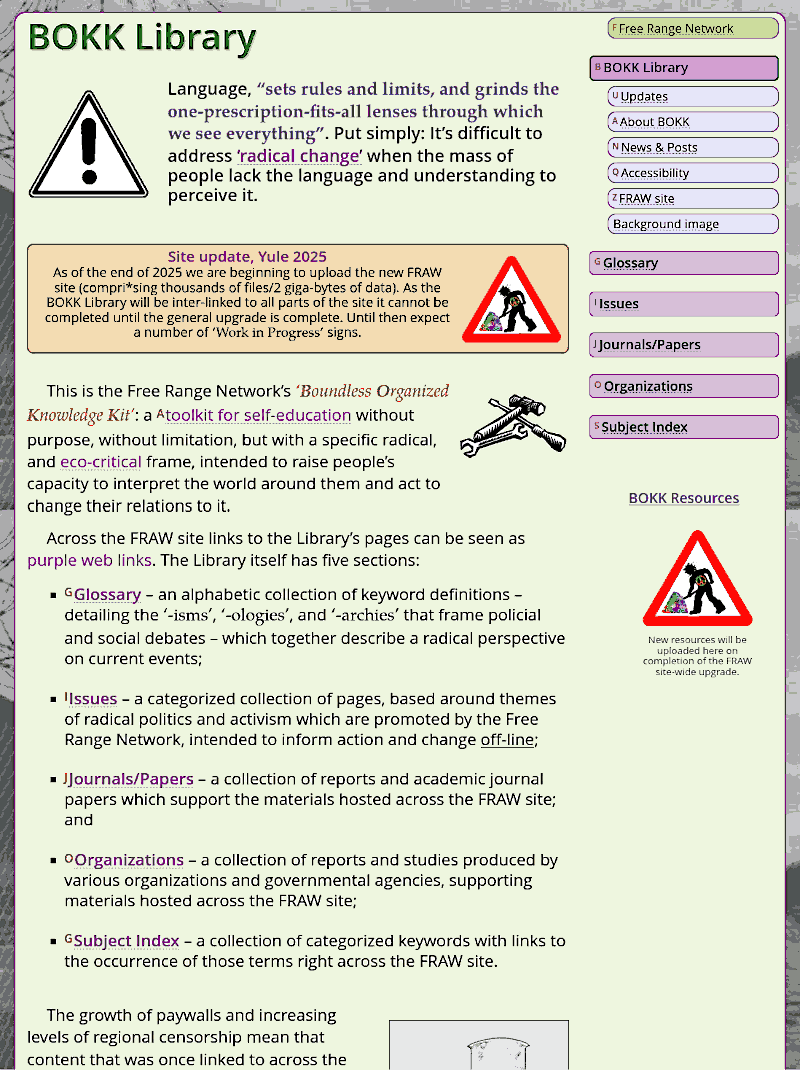
We call the core of the new structure for the FRAW site the ‘BOKK Library’ – ‘BOKK’ standing for ‘Boundless Organized Knowledge Kit’ (since theoretically we can just keep expanding this new structure with new content ad-infinitum).
As every page on the FRAW site has been updated and re-coded; and every paragraph, image, quote, subsection, and reference link, has been given a unique bookmark ID.
The BOKK Library’s ‘Subject Index’ uses keywords, oft-used phrases, and proper names to collect these bookmarks together under a common heading, linking directly to the specific paragraph, image, etc. across the entire site – meaning that it is possible to roam the site directly by keyword without requiring those problematic search engines to get involved.
As the FRAW site is brought back section-by-section the content of the Subject Index will expand to cover each of those updated areas. Existing keyword lists will lengthen the number of references they contain, and new keywords will appear to cover new topics. Note that most keywords also links to Wikipedia pages, articles, and papers/journals to give further information about it, and where words have complex relations they are grouped together with internal links jumping across the Subject Index.
Note also that as part of this process we’re progressively eliminating PDF files from the site (that may take another year or two), converting them into single of structured HTML file(s) to allow this process to roam across the entire content of the site. There are a whole load of reasons for this, but primarily it’s about maximizing accessibility.
In addition to the Subject Index there are two very related areas: Journals; and Organizations.
The content of the FRAW site contains many links to reports and journal papers within the text of each document. As we re-code the pages, those links now jump to a single short summary about that reference, giving not only a ‘free’ source for that document, but also, like the Subject Index bookmarks, linking to all the locations where that reference has been used across the site.
Finally, because of the potentially fraught status of sites like Wikipedia, which we have extensively linked to for years, we have also created: A ‘Glossary’ to define key terms which, over time, may take the place of these other Internet sets; and an ‘Issues’ area, to bring together resources from across the site around specific areas of interest to the Free Range Network (albeit this last section will not be properly working until 2027, because all the rest of the site must be reinstated first).
That’s why the process has required so much work, and why it’s taken so long.
So why do it?

In effect we’re returning to the structure of the site in the late 1990s – to serve the purposes for which we originally created it. Yes, the activist content is key, but the ability to relate and extract useful information, in ways that we might not be able to see but other may, is far more important.
The new site will retain much of its original content, but the primary purpose of the site is to create and communicate a framework, a ‘pedagogy’ for activist knowledge and resources, without restriction or definition on our part.
Just as thirty years ago, the structure of the site enacts our ambition to create ‘Free Range’ activism, where people can work with us, or freely take our resources, to undertake the activities they desire rather than what we think are important – and in return all we ask is that we are copied-in on the outcomes so we can network the best and most creative examples with others.
Once everything is in place in late 2026, then we can start to ‘play’ with it. We’ll be putting the ideas for that in place over the first half of the year, before we create our materials for the festival season in the Summer. Until then we hope what we progressively put-up is of use, and we thank everyone for their patience while we’ve undertaken this gargantuan process.